

College of Security Studies
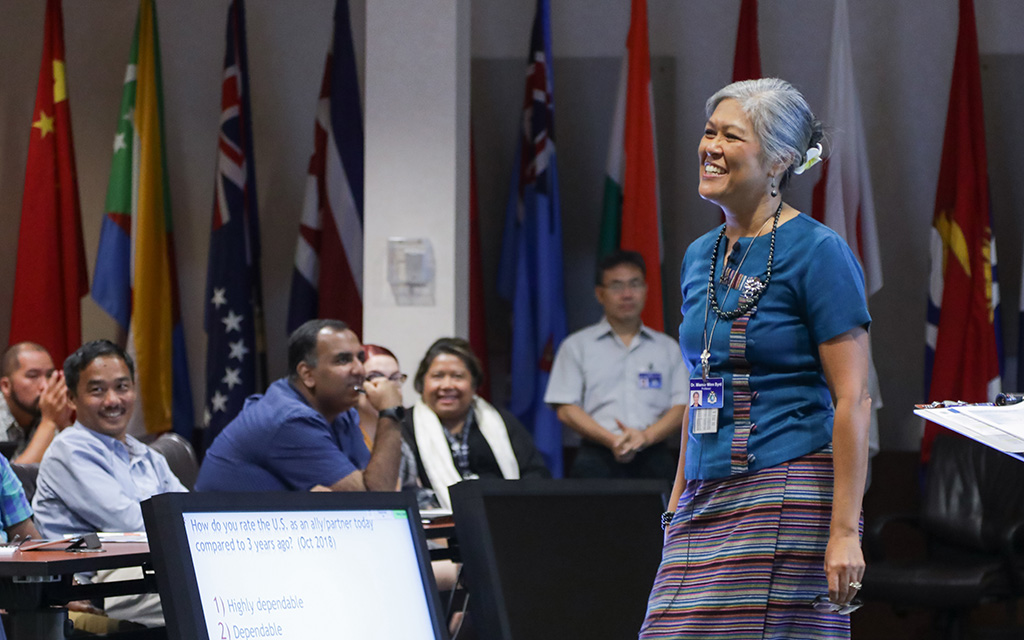
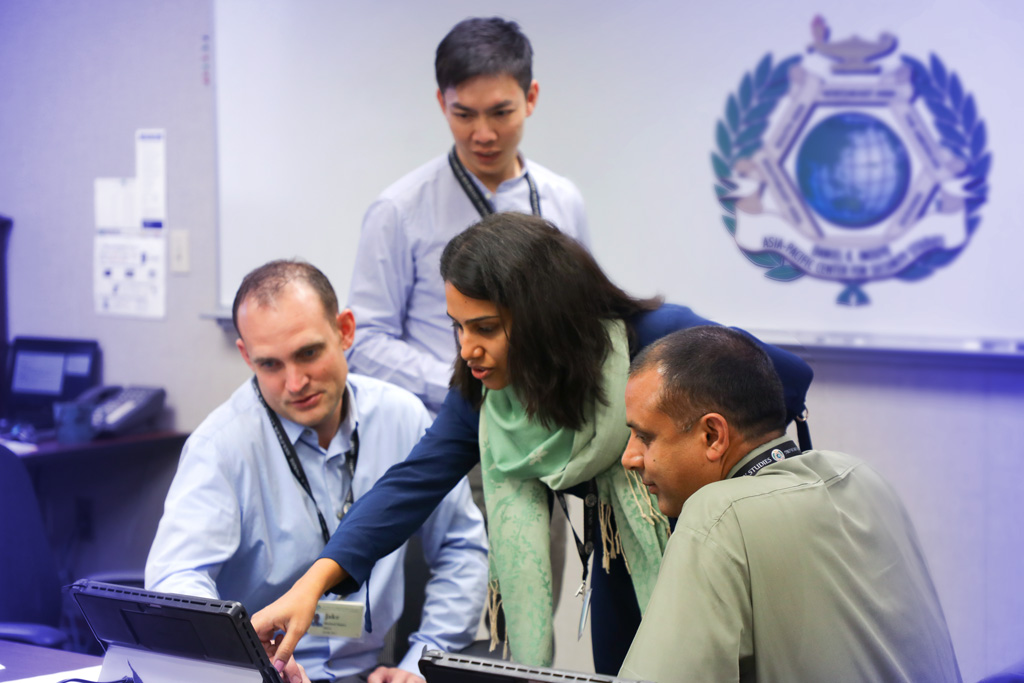
Fellows in the College come from throughout the region and consist of senior military and government civilian equivalents in security-related positions.
Courses:
- Transnational Security Cooperation (TSC) for senior executives
- Advanced Security Cooperation (ASC)
- Comprehensive Security Responses to Terrorism (CSRT)
- Comprehensive Crisis Management (CCM)
- Senior Executive Asia-Pacific Orientation Course (SEAPOC)
- Asia-Pacific Orientation Course (APOC)
Please note: Potential students are not allowed to register themselves into any course without the official endorsement/nomination from country’s ODC/Embassy or APCSS registrar.
TSC
Transnational Security Cooperation (TSC), for senior executives
Description.
An intensive program for current leaders on the upward track for more senior positions of significant national (and possibly international) responsibility. Designed for Asia-Pacific senior security practitioners from whole of government and society at the ambassador/vice-minister ( one- to four-star military) level. The intent is to replicate a forum consisting of practitioners who influence security cooperation at the highest levels. Curriculum emphasizes the impact of change in the region, as well as capacities – – leader and institutional – – to manage change. The course integrates a challenging program of guest speakers, along with interactive seminar workshop dialogues and collective action-planning. Course attendees join an expanded network of contacts among regional security practitioners that include their fellow classmates and APCSS faculty, as well as a regional “community of interest” via a dedicated web portal used by APCSS alumni and others.
ASC
Advanced Security Cooperation (ASC)
Description:
The Advanced Security Cooperation (ASC) course is designed to advance knowledge, skills and networks related to multilateral security cooperation in the Asia-Pacific Region among mid-career security practitioners. The course stimulates strategic analysis and understanding of major security trends and challenges in the region, explores available and desirable tools and processes to mitigate challenges, and the requirements necessary to develop national security sector capabilities. The course enhances individual leader skills in critical thinking, communication, collaboration and decision-making in complex multinational and culturally diverse environments. Emphasis is placed on enhancing partner capacity through the formation of communities of interest in various areas of security practice.
For additional information about the Advanced Security Cooperation (ASC), click on the following hyperlinks:
CSRT
Comprehensive Security Responses to Terrorism Course
Description:
This course provides CbT security practitioners in the Asia-Pacific region, as well as other designated countries around the world, the operational and strategic-level skills necessary to enhance their ability to understand and combat terrorism and transnational threats. Through faculty lectures, guest speaker presentations, real-world case studies, seminar discussions and tailored exercise scenarios, CSRT Fellows explore the nature of today’s terrorist threats, better appreciate the challenges associated with countering ideological support for terrorism and violent extremism, achieve a more common understanding of global and regional terrorism challenges, analyze tools and capabilities for combating terrorism and transnational threats in order to promote appropriate strategies. The CSRT course is designed to build relationships between and among the United States and current and future CbT practitioners of participating countries in order to develop trust, confidence and specific methods necessary for increased information sharing, reduction of obstacles to cooperation in the international collaborative effort against those who use terror to achieve goals. The curriculum focuses on the non-warfighting aspects of security and is divided as follows: Understanding; Framing and Assessing the Challenge; Formulating Responses to the Challenge; and Strategy Application. After leaving the Center, CSRT graduates are able to continue their collaborative efforts through IT/ET enabled portal connectivity.
For additional information about the CSRT Course, click on the following hyperlinks:
CCM
Comprehensive Crisis Management (CCM)
Description:
The Comprehensive Crisis Management (CCM) Course is a 4-week course that focuses on developing leader skills in five core areas: Comprehensive understanding of the complexity of crisis situations, strategic assessment, cooperation and collaboration, communication and use of appropriate technology. Offered once a year, the course is ideal for practitioners whose current or future responsibilities lie in the field of crisis management and recovery. Mid-career to senior practitioners including 0-4 (Major) to 0-6 (Colonel)- level military personnel, and civilian equivalents from diverse backgrounds such as law enforcement, government ministries and disaster management authorities are welcome to attend. Participants are also encouraged from NGOs, regional and international agencies and organizations, and academia. Participants come from all over the Asia-Pacific region, and in any one course may be drawn from as many as 45 nations and entities.
Crises are dramatic disruptions in the political, economic and social life of a nation. Their causes are diverse and range from conflicts to natural disasters, but they can seriously disrupt a population’s capacity to survive and the ability of national authorities to respond. Reflecting their complexity and scale, crises require a response that is well-coordinated and multi-sectoral in nature. Very often, the assistance of international actors may also be needed. Therefore, the course will emphasize broad, strategic-level themes and considerations rather than tactical prescriptions.
SEAPOC
Senior Executive Asia-Pacific Orientation Course (SEAPOC)
Description:
SEAPOC brings together senior U.S. military and civilian leaders along with ally and partner counterparts to consider the complex, evolving security challenges and opportunities in the dynamic Asia-Pacific region. This two-and-a-half-day course includes an orientation to the major trends and potential outcomes in the Asia-Pacific and a consideration of the challenges presented by a multi-actor, multi-sectoral Asia-Pacific security environment. The curriculum supports critical thinking about these topics through an intensive program of lectures and interactive discussions, as well as elective sessions, and collaborative seminar workshops.
For additional information about the Senior Executive Asia-Pacific Orientation Course (SEAPOC), click on the following hyperlinks:
APOC
Asia-Pacific Orientation Course (APOC)
Description:
The course provides an introduction to Asia-Pacific culture, politics, protocols and challenges, while addressing U.S. interests in the region. The curriculum is focused by day and examines: Day One) Regional Perspectives, Day Two) Treaty Alliance Partners & Security Challenges, Day Three) Key Regional Players & Security Challenges, Day Four) Regional Issues, and Day Five) Transnational Challenges. Attention is given to both historical and emerging issues. The course includes a rigorous program of lectures and interactive sessions, and three break-out seminar sessions.
Faculty:
For more information, contact the APCSS registrar,
at (808) 971-4059.


